
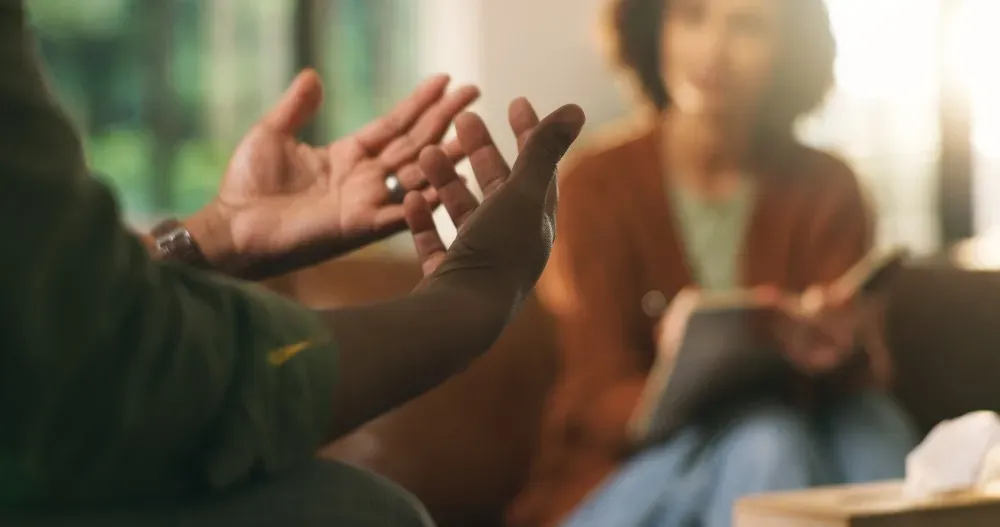
When you struggle with your mental health, mood, or relationship, sometimes it feels like there's no one in the world that you can confide in or trust. You’re anxious, depressed, and you feel alone. There’s a safe space to get help.
You aren’t yourself anymore. You aren’t the self you want to be. You’re angry and strike out at loved ones. Or you’re depressed, and you’ve withdrawn from friends and family.
Perhaps you’ve started to self-medicate using alcohol and drugs, which, in turn, has begun causing other problems in your life. Or maybe what was once a loving relationship has become cold or even violent.
When your life takes a turn for the worse, it can be hard to find help. Sometimes it’s even hard to believe there’s help and that your situation can improve. And, even if you believe there could be help, you may not have the mental energy or focus to find it and pursue it.
You’ve taken the first step. You’re reading this blog. And we’re here to tell you there’s a safe space to come, heal, and get back to the life you really want.
At The Soho Center for Mental Health Counseling, our expert counselors work with you to find the therapies and support you need to feel in control of your life and to become happy and healthy. We offer safe spaces in our Greenwich Village, New York City, and via HIPAA-compliant teletherapy.
How can we help you heal? Read on to find out.
You aren’t alone
Despite social progress, mental illness still has a stigma attached to it. But one in every 20 women, men, and children in the United States experiences mental illness every year. One in 20 struggles with a serious mental illness.
So, even though everyone around you may seem like they're living an ideal life, that may be an illusion. Statistically speaking, they or someone they love probably also struggles with mental illness, relationship troubles, or substance use.
Getting help not only improves your mental state, but it can also prevent you from developing serious physical illness. Women, men, and children with untreated depression, for instance, have a 40% higher risk for cardiac disease, hypertension, stroke, diabetes, metabolic syndrome, or obesity. Mental health treatment increases wellness overall.
A therapist plays a neutral role in conflicts
Couples counseling and family therapy give you and your loved ones a safe place to talk about any issues you’re experiencing. Your therapist is a neutral observer and mediator who helps you learn to discuss even the most upsetting subjects without blame or triggering.
Eventually, through techniques such as cognitive behavioral therapy (CBT) and dialectical behavioral therapy (DBT), you can learn to express your emotions clearly and calmly. Your partner and family members do, too, which eases conflicts and creates more harmonious relationships in all aspects of your life.
You learn to handle stress safely
If you’re angry all the time, strike out at other people, or self-medicate, these “strategies” to regain control can diminish your quality of life. You may have lost an important relationship or a job, or are in danger of doing so.
Or, you could be struggling with past trauma that haunts you to this day. You have post-traumatic stress disorder (PTSD) due to military combat, witnessing a horrible accident, or experiencing rape, sexual abuse, or other abuse or trauma.
Your expert counselor helps you identify the feelings underneath the anger or despair using healing techniques such as eye movement desensitization and reprocessing (EMDR). You learn to process your experience and distance yourself from it so that it loosens its grip on you.
Participating in individual and group counseling for substance abuse can provide valuable tools for recognizing and steering clear of triggers if you struggle with anger or substance use. You learn how to resist cravings through various therapies. We may also give you medications that help lower the physical discomfort of breaking an addiction.
You get help through hard times
If you’re grieving the death of someone you loved (even a pet), a loss of a job, or a loss of a relationship, you may not be getting the support you need. Those around you may have decided that “it’s time” that you move on and don’t want to hear any more about your sadness. But you aren’t ready to move on.
Our culture doesn’t have rituals to express grief and loss or communities to support the grieving. If you don’t know how to move on from your loss, our counselors help you process your feelings and reframe them so that you can honor your loved one (or job or marriage) and still move toward the future.
Whether you’re dealing with depression, anxiety, substance abuse, anger, eating disorders, or other issues, we’re here to help. Call us or use our online appointment form to book mental health therapy at our Greenwich Village, New York City office or via HIPAA-compliant teletherapy sessions today.